Here is a collection of ideas and activities for teaching academics to toddlers through elementary school students, based on my own teaching career as well as raising children.
These are in project based and thematic learning activities, to extend traditional learning.
Translate
Showing posts with label lower elementary. Show all posts
Showing posts with label lower elementary. Show all posts
The Many Colors of Harpreet Singh is a inclusive way to teach feelings in relation to colors, while diversifying reading for children.
A young Indian boy moves to the United States and wears a patka, a style of Sikh turban. Each day he wears a specific color that depicts his mood.
A follow up activity could be to have students draw themselves wearing a special piece of clothing and write about a feeling.
Some free websites that I find useful with my students are:
Reading:
For beginning reading skills Reading Bear is a resource that approaches reading phonetically and begins at a very basic level, with letter sounds.
StoryWeaver allows children to hear books in both English and other languages. Text levels are not very challenging, so it's better for younger students or beginning readers.
Math:
To work on specific lessons and skills, Splash Math allows some free accounts for teacher's to tailor and assign tasks. Videos & Lessons:
Khan Academy gives lessons on a multitude of topics. TeacherTube gives students the advantage of watching a video of a teacher teaching lessons and is searchable by content.
Bilingual Kidspot has a variety of poetry, nursery rhymes, and videos in different languages for kids to interact with.
One unit that I like to do each year with my ELL students, is to work with wordless picture books. Sometimes we sit in a small group in a read aloud format and talk through the book together, with me doing most of the talking. At other times we each think of a line to the story as we page through the book. Some books are available on Kindle, through local library sites, or on YouTube, so that they can be projected and charted or written the board.
Later, I have students write their own versions of the story, and if they have time they can redraw the illustrations and make a book.
Wordless books are so great for integrating a number of lessons, from using strong adjectives, to story telling, writing stories, increasing vocabulary, etc.
Here are some of our favorites:
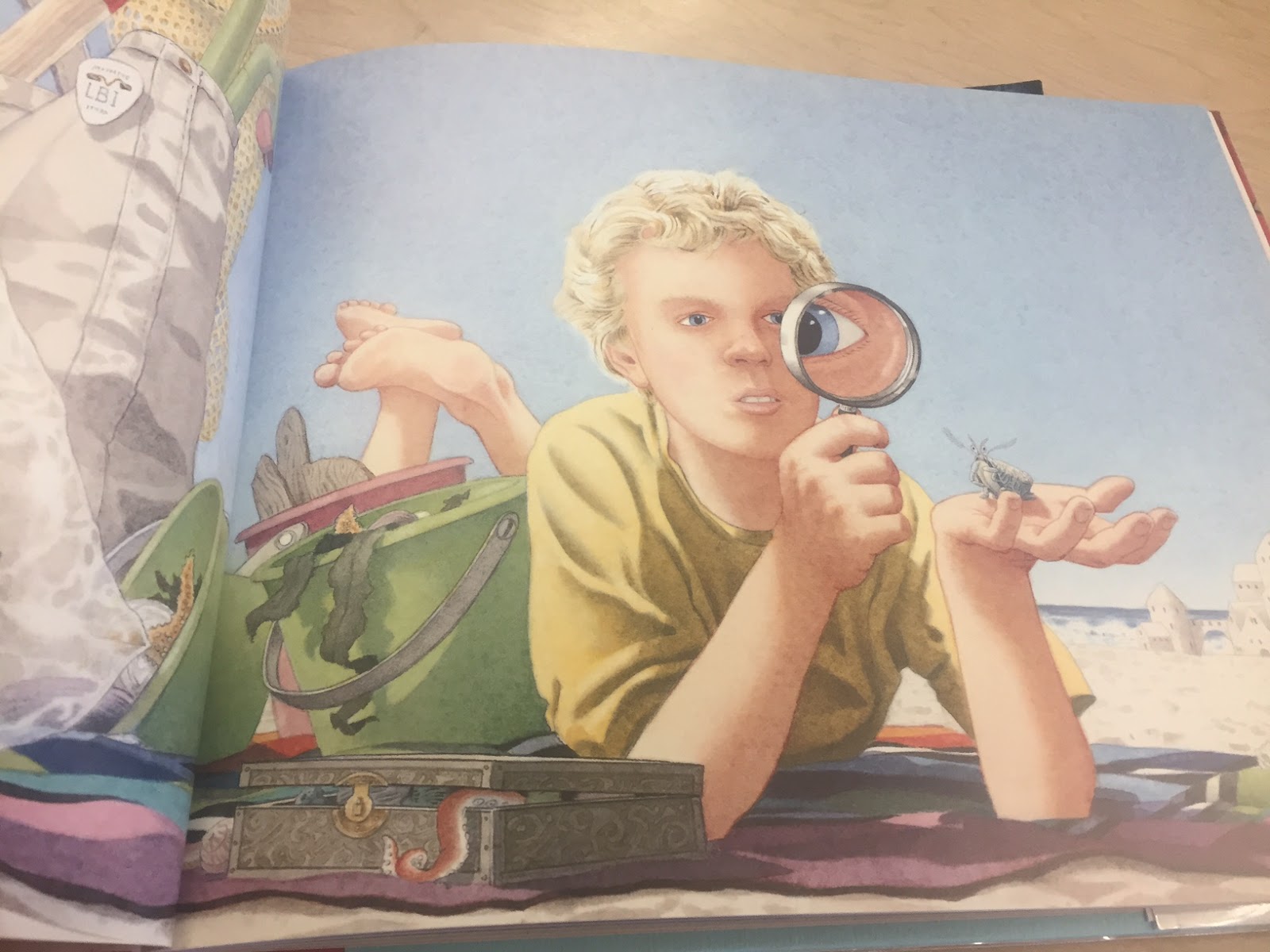
David Wiesner has a number of wordless books, most all with fantasy elements.
Tuesday is a very popular choice among the kids, but Flotsam, and Sector 7 are also fun and beautifully illustrated.
A children's librarian would have a better idea of what is locally available, but another new book that is lovely is Here I Am. Which illustrates the arrival of an immigrant child in a large city and his experience as he becomes more familiar with his surroundings.
A very cool book is Journey, by Aaron Becker. This dreamy story transports the main character through a fantasy adventure.
Pancakes for Breakfast, by Tomie DePaola, walks through the process of a grandmotherly type lady making pancakes one winter morning, beginning with collecting eggs at dawn. It embodies the humor typical of Tomie DePaola, with friendly animals.
We measured some folks around the school when the students were studying centimeters (they questioned who was the tallest teacher/principal, as well as Abraham Lincoln. I then printed photos of them and we arranged them in order from shortest to tallest, etc and used verbal statements to make comparisons.
Since the students have now moved onto money, each of the people were assigned a handful of change, which we then counted and ordered from least to greatest and so on.
These are pieces of PVC elbow pipe, available at big hardware stores, such as Home Depot and Lowes. I use them for primarily three things: reading fluency, hearing letter sounds, and revising writing.
The sound through the pipe accentuates what they hear and they are more cognizant of how they are pronouncing. It really helps some children hear the vowel sounds that they are making.
The kids love using them and are excited to reread a book or poem while they "listen" to themselves read. They only have to read at a very low volume to hear themselves, so several children reading at the same time is not a problem.
When we are revising writing, I have the students read their writing quietly to themselves (usually sitting at an area like a writing center) and then go back and read it a second time using a blue pen to make changes. Sometimes they are reading for flow, sometimes with a purpose, such as adding strong verbs or similes and metaphors.
The piping is inexpensive and can be decorated with puffy paint, stickers, or names written in Sharpie (it wipes off with rubbing alcohol at the end of the year). It's a fun tool to have in the classroom.
After reading several tall tales aloud and different versions of the same tales, my students wrote their own tall tales. We edited and revised them and typed them. The students created the main character and pasted the exaggerated tales on their bodies.
Some reading programs use tactile or sensory experiences for students to learn letters or letter sounds. Montessori schools for example, use sandpaper letters as students develop literacy skills. The Orton-Gillingham reading intervention program also uses sensory experiences, such as students tracing letters in sand or rice.
Materials: index cards or oak tag (if using oak tag- scissors or a paper cutter), pencils, liquid glue such as Elmer's glue, colored sand from a craft store, measuring spoons/small scoop, a container to hold the sand
- you may want newspaper or paper on the table & probably a dust pan and brush for afterwards!
Process:
This activity can be made with the students and used in a variety of ways.
1.) On an index card or pre-cut piece of oak tag and write the letters in pencil.
2.) Students go over the letter in glue (either by squeezing the glue bottle or going over it with a Q-tip and glue).
3.) Students take a scoop of sand and sprinkle it over the letters. Shake off the excess sand and leave it to dry for a couple of hours.
Uses:
I often just make the vowels with the students to take home, but have a set of the whole alphabet.
in reading groups
students say the letter name and sound and trace over them with their fingers
the students can hold up a letter when they hear the letter sound in a word
Building gingerbread houses with the students is a seasonal activity that also develops oral language, reading and writing, and integrates Common Core Standards of science and technology. Before we built the houses, we read some books about gingerbread houses (Jan Brett's TheGingerbread Baby) and a few different versions of the Gingerbread Boy.
We have also been writing and reading directions about building a gingerbread house. For older students, they read a passage from ReadWorks.com and answered questions. With the younger students, we wrote out on chart paper directions for putting together a gingerbread house. Later children wrote about constructing their gingerbread houses in an informational piece and wrote a fiction
Materials for house construction:
Non-edible: paper plates, muffin tin liners (for holding various decorating candies), small cups (Dixie cups work well for icing), popsicle sticks or knives for spreading icing, a bowl for mixing, hand mixer, if you are feeling adventurous- sandwich bags to use to "pipe" the icing
Optional: a disposable table cloth, paper towels, small (rinsed and emptied) milk or juice cartons to build around
Food items: egg whites (Egg Beaters are a good bet, they are pasteurized and no need to separate eggs), confectioner's sugar, cream of tartar, and graham crackers. For decorating- the lighter the candy, the more likely it is to stick- sprinkles, Nerds, M & Ms, chocolate chips, more traditionally- gum drops and candy canes, but they are both heavy!
There are a variety of recipes for Royal icing, the white icing that hardens when it dries, here is one that I used:
3 cupsconfectioners' sugar
2egg whites, beaten
1/4 teaspooncream of tartar
Royal icing can be colored with food coloring - makes 4 cups (*if kids eat the icing, the eggs should be pasteurized)
Process: 1.) Set up and out all of the materials Each child receives: a paper plate, a milk carton, a small cup for icing, a popsicle stick or disposable knife, 6 graham cracker pieces 2.) Make the royal icing according to recipe 3.) Children build the houses around the milk carton 4.) After 5-10 minutes of drying time (they can read or color after washing their hands) start decorating
This was mad with gluten-free graham crackers, so proportions are different.
This is a super messy (but fun) activity- be prepared!
Such a great autumnal activity for any age group, because it can be
extended and used in so many ways. I do this with my preschooler just
for fun and to create fall decorations, but at school, we can write leaf
haikus, categorize leaves, as part of a nature study, for descriptive
writing, leaf graphs- the possibilities are endless.
Materials:
leaves
paper (copy paper or scrap paper works well)
crayons (with paper peeled)
The first step is collecting leaves that are fairly freshly fallen and not too dry and brittle.
Collect them in varying shapes and sizes (though smaller leaves are easier for smaller children).
Place
the leaves under the piece of paper and with the side of the crayon,
rub over the top of the paper. The outline of the leaf and all of the
spines will appear.
An easy, low prep activity for welded sounds, blends, etc.
Materials: cups (plastic or small coffee cups work well), permanent markers, scissors
- adjust cup size to the development age/fine motor skills of child
Steps: Pre-cut rectangular windows on each cup.
1. Give each child a permanent marker and have them write a blend or welded sound next to
the rectangle.
2. Stack the cups.
3. In the window, have the child write the rest of the word.
4. Rotate one cup and in the next space, write the another word part.
5. Continue to rotate until words have been written in each space.
6. Draw eyes at the top of the cup and a mouth around the word rectangle.
7. Have the students read the words.
You can create a group of ghosts that review several sounds or have all children write the same words.
I've done this with almost every level of student that I have taught. It's similar to the game telephone, in which you start a story and pass it along, although this story is written down. I write a story starter the first time we do the activity on the top of a piece of paper, one for each student in the class. (Or you can write one for a center activity and leave it there throughout the week). Each student writes a sentence or paragraph and passes the story along, until everyone has added to it. Then the stories are shared aloud at the end. This works really well with upper elementary and high school level students. I use it a lot with ESL students and reading aloud at the end is fun for everyone and helps them work on pronunciation. Kids are also not shy about sharing because the writing belongs to the group and is not solely theirs.
After you have done the activity once or twice, the kids like to start the stories themselves.
This activity can take a lot of time, if you are passing the writing around the whole class. To shorten the amount of time, you can limit it to small groups, chart paper in which kids add when they have time, or as mentioned above, leave it at a center.
Planting seeds are a great science, math, writing activity that can be tied into literacy thematically with books like Titch, seed or gardening books. They can be simply a fun activity or a daily exercise in graphing, writing, observation, and recorded through science journals.
Bean plants grow the most quickly and can be done as simply as by dampening a paper towel, folding it around a couple of seeds and placing them in ziplock bags. This year I used sunflower seeds and clear Starbucks cups (reuse) and tied a ribbon around them as an end of the year present.
We grew them in math class and charted the growth on graphs each day. A good tip is to always grow a couple of extra at home to switch them out if need be ; )