Translate

Showing posts with label writing. Show all posts

Wednesday, October 9, 2019

Books About Emotions

 The Many Colors of Harpreet Singh is a inclusive way to teach feelings in relation to colors, while diversifying reading for children.
A young Indian boy moves to the United States and wears a patka, a style of Sikh turban. Each day he wears a specific color that depicts his mood.

A follow up activity could be to have students draw themselves wearing a special piece of clothing and write about a feeling.


Thursday, January 25, 2018

Castle Unit and Read Alouds

(A work in progress)


Using castles to thematically teach in reading and writing:

References for kids:  

I Wonder Why Castles Had Moats- Philip Steele

Castles- David Macaulay


Read alouds:

A Brave Princess- Beatrice Masini
  to discuss characters

Tumble Tower- Anne Tyler


Math related:

Sir Cumference and the Round Table
 - draw and measure the perimeter or circumference of tables and/or moats
Other Sir Cumference Books

How Big is a Foot?


Writing:  

- Describe a castle in detail- project a photo on the board and brainstorm whole group descriptive words
- Write about the adventure of a knight


Wordless Books

One unit that I like to do each year with my ELL students, is to work with wordless picture books.  Sometimes we sit in a small group in a read aloud format and talk through the book together, with me doing most of the talking.  At other times we each think of a line to the story as we page through the book.  Some books are available on Kindle, through local library sites, or on YouTube, so that they can be projected and charted or written the board. 

Later, I have students write their own versions of the story, and if they have time they can redraw the illustrations and make a book.

Wordless books are so great for integrating a number of lessons, from using strong adjectives, to story telling, writing stories, increasing vocabulary, etc.

Here are some of our favorites:

David Wiesner has a number of wordless books, most all with fantasy elements. 

Tuesday is a very popular choice among the kids, but Flotsam, and Sector 7 are also fun and beautifully illustrated. 

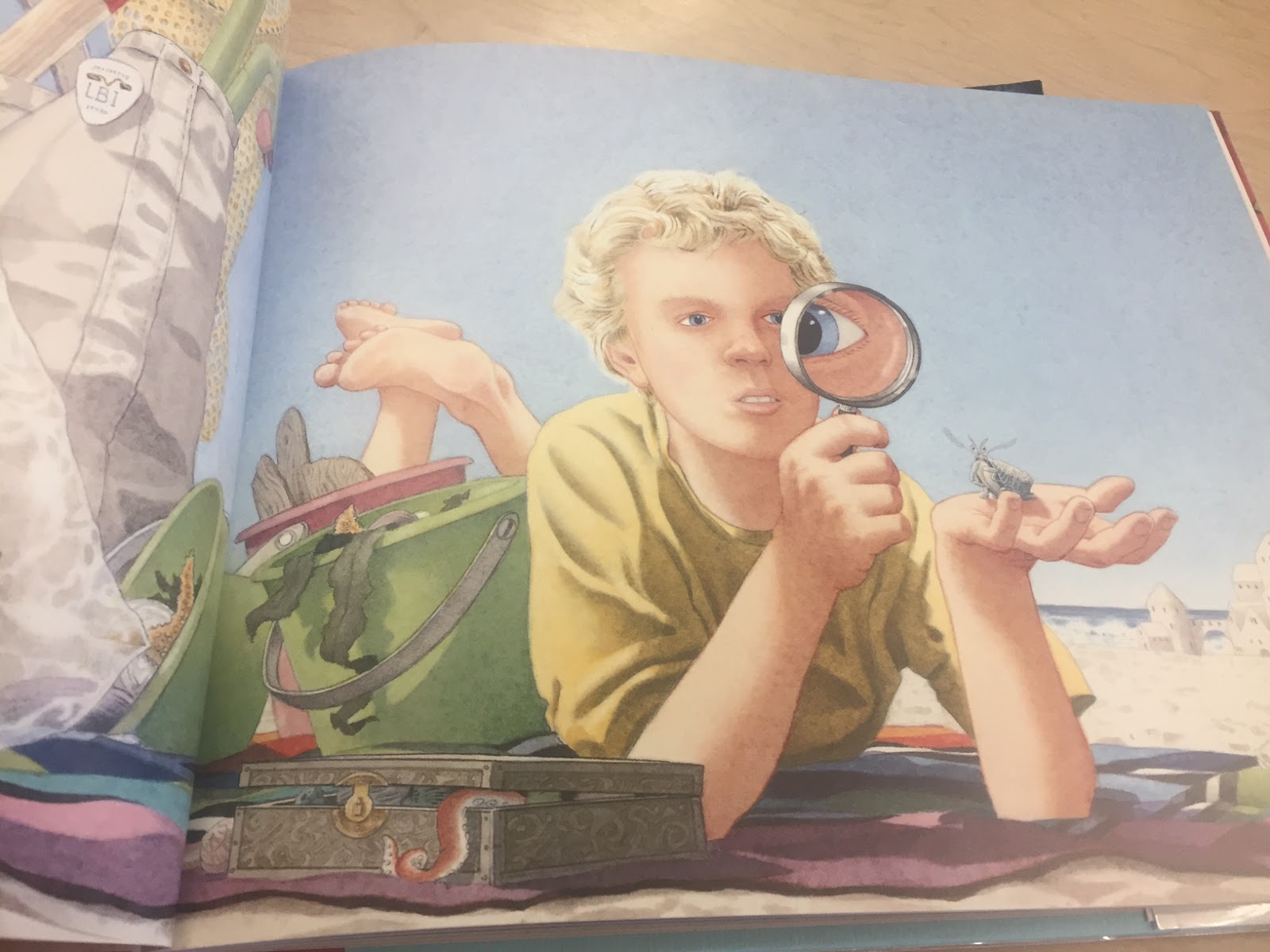
A children's librarian would have a better idea of what is locally available, but another new book that is lovely is Here I Am.  Which illustrates the arrival of an immigrant child in a large city and his experience as he becomes more familiar with his surroundings.

 A very cool book is Journey, by Aaron Becker.  This dreamy story transports the main character through a fantasy adventure. 

Pancakes for Breakfast, by Tomie DePaola, walks through the process of a grandmotherly type lady making pancakes one winter morning, beginning with collecting eggs at dawn.  It embodies the humor typical of Tomie DePaola, with friendly animals. 

Other titles include:  The Wave by Suzy Lee, Unspoken by Henry Cole (a story of the Underground Railroad), The Flower Book by Mark Ludy, and The Girl and the Bicycle by Mark Prett.


Wednesday, March 11, 2015

Clouds

We read a few cloud books and followed up with painting clouds.  This activity can be used for younger children with creating clouds and developing fine motor skills, or with older children studying weather and cloud types.  It's also a great way to paint snow or snowmen!


The cloud book we started with was Little Cloud by Eric Carle.  We read the book out loud a few times and then created our own clouds on blue construction paper.  To create our cloud mixture, I mixed equal parts liquid glue (such as Elmer's) and shaving cream.  It forms a sticky, fluffy substance (great for developing oral language and discussion) that can be painted/sponged/finger painting/foam brushed onto paper.  It will dry almost as puffy paint, in a textured, raised bubble, depending on how much is applied.  The children then wrote a story about a cloud.
Various clouds by kindergarteners.


This activity is also perfect for the Cloud Book, by Tomie De Paola and creating each type of cloud.

Sunday, July 20, 2014

Robots

This is another speaking exercise in which students work in small groups to brainstorm ideas and then execute the illustration (or build a model if you are so inclined)!
The assignment is to design a robot that helps society in some way.  You can make the assignment broad or more specific.  The last time I gave it, it was with a group of fifteen year olds and we only had a half an hour to work with, so I left the assignment open, but with a time limit.  When they had completed their work, they had to explain it to the class and be open for questions and conversation.

A fun extension to the assignment is to have the students write a (fiction) story about some of the robots that their classmates have designed.


Materials:  chart paper, markers or crayons

one example of a robot

another example from the same group of students

Tuesday, July 8, 2014

Personal Timelines (Vertical format)

There are so many ways to do timelines, here is one example from an ESL summer program in which I teach.  Students chose major events from their lives (birthday, a sibling's birth, entering school, etc) and recorded them on a rectangular piece of paper.  We then hung them with ribbon and the students presented their own timeline to the class.  This was primarily a speaking exercise, but can be used for developing writing skills also.  I have used this at varying grade levels, though these students are fifteen years old.
Display of class timelines.

Close up of timeline.


Another rectangle on a student's timeline.


Monday, March 31, 2014

William Steig Author Study Overview

We worked on a  William Steig author study unit, reading a number of his books and did various activities with them.
Some of the activities were:
  • Venn diagrams comparing two books
  • reading information about William Steig and writing biographies
  • character descriptions (both physical and character traits)
  • class discussions of story elements with story charts
  • a writing prompt about finding a magic object, like the pebble from Sylvester and the Magic Pebble
  •  discussion of magic in books
  • writing about his New Yorker covers
We collected work in folders, on which the children did water color illustrations of one of the characters from his books, which they first outlined with ink.

Books: (there are others in addition, these were readily available)
Shrek, Sylvester and the Magic Pebble, Amos and Boris, Doctor DeSoto, Doctor DeSoto Goes to Africa, Brave Irene, The Amazing Bone, Spinky Sulks


Wednesday, February 27, 2013

What Happens Next?


I've done this with almost every level of student that I have taught.  It's similar to the game telephone, in  which you start a story and pass it along, although this story is written down.  I write a story starter the first time we do the activity on the top of a piece of paper, one for each student in the class.  (Or you can write one for a center activity and leave it there throughout the week).  Each student writes a sentence or paragraph and passes the story along, until everyone has added to it.  Then the stories are shared aloud at the end.  This works really well with upper elementary and high school level students.  I use it a lot with ESL students and reading aloud at the end is fun for everyone and helps them work on pronunciation.  Kids are also not shy about sharing because the writing belongs to the group and is not solely theirs.
After you have done the activity once or twice, the kids like to start the stories themselves.
This activity can take a lot of time, if you are passing the writing around the whole class.  To shorten the amount of time, you can limit it to small groups, chart paper in which kids add when they have time, or as mentioned above, leave it at a center.


Sunday, February 26, 2012

Read Alouds for Teaching the Six Traits

I don't even remember where I got this list to reference it, and I think I've also added to it.  I use it every year that I teach writing though and love so many of the books on it!

Ideas and Content


  • Miss Nelson is Back by Harry Allard & James Marshall
Suspense

  • Everybody Needs a Rock by Bryd Baylor

  • The Best Town in the World by Bryd Baylor

  • The Important Book by Margaret Wise Brown

  • Take Time to Relax by Nancy Carlson

  • The Armadillo from Amarillo  *

  • Miss Rumphius by Barbara Cooney  *

  • Goldilocks Returns by Lisa Campbell Ernst

  • Thank You Mr. Falker by Patricia Polacco

  • Wilfrid Gordon McDonald Partridge by Mem Fox*

  • On the Day You Were Born

  • When Jesse Came Across the Sea

  • Yeh-Shen: A Cinderella Story by Ai Ling Louie

  • The Three Javelinas by Susan Lowell

  • Roxaboxen by Alice McLerran

  • The Kissing Hand by Audrey Penn

  • Kafi and his Magic by Maya Angelou

  • Verdi by Janell Cannon
Research to story writing connection

  • I Hate to Read!  By Rita Marshall

  • A Drop of Water by Walter Wick*

  • Mufaro’s Beautiful Daughters

  • All the Places to Live

  • Amelia’s Notebook  *

  • The Other Way to Listen

  • A Chair for My Mother  *

  • If You Were a Writer
focus

  • I’ll Always Love You

  • Fireflies!  *

  • Smoky Night  *
moment in time

  • The Great Kapok Tree*

  • The Beach Before Breakfast
moment in time

  • The Paperboy
moment in time

  • When I Was Young in the Mountains
moment in time

  • I’m in Charge of Celebrations *

  • Aunt Flossie’s Hats  *
Memory

  • Owl Moon  *
 moment in time

  • The Pain and the Great One
everyday experiences

  • A Sweet Sound Basket

  • The Story of Ruby Bridges

  • Home Place

  • Lightning
Expository

  • Letters from Felix

  • Grasper
Methaphors, writing + geopgraphy

  • Go Home, River!
Own personal journey

  • Benito’s Dream Bottle
Stretch imaginations through language

  • Mississippi Beau
Use of research & info to inform and tell a story at same time

  • A Street Called Home

  • Panther Dream- wc

  • Nurse Lughton’s Curtain

  • My Mama Had a Dancing Heart

  • Pink and Say- Patricia Polacco

  • Aunt Harriet’s Underground Railroad in the Sky

  • The Relatives Came - Cynthia Rylant

  • The Squiggle- Carole Lexa Schafer

  • Where the Wild Things Are- Maurice Sendak

  • Sheep Out to Eat- Nancy Shaw

  • Pete’s a Pizza- William Steig

  • Say Something- Mary Stoltz

  • Jumanji- Chris Van Allsburg

  • The Mysteries of Harris Burdick- Chris Van Allsburg

  • Harry Potter and the Sorcerer’s Stone- J.K. Rowling

  • Dear Mr. Blueberry- James Simon

  • Whoever You Are- Mem Fox

  • Fables- Arnold Lobel

  • Throw Your Tooth on the Roof: Tooth Traditions- Selby Beeler

  • A Drop of Water- Walter Wick

  • Tree of Life: The World of the African Baobob- Barbara Bash

  • The New Way Things Work- David Macaulay

  • Magic School Bus at Waterworks- Joanna Cole

  • It’s Disgusting and We Ate it- James Solheim

  • Sweet Words So Brave- Barbara Curry

  • Marvelous Math: A Book of Poems- selected by Lee Bennett Hopkins

  • The Disappearing Alphabet- Richard Wilbur

  • Motel of Mysteries- David Macaulay

  • The Secret Knowledge of Grown Ups- David Wisniewski

  • The Story of Ruby Bridges- Robert Coles

  • Snowflake Bentley- Jacqueline Briggs Martin

  • The Flag We Love- Pam Munoz Ryan

  • My Rotten Redheaded Older Brother- Patricia Polacco

  • Twister- Darleen Bailey Beard

  • Messages in the Mailbox- Loreen Leady

  • A Porcupine Named Fluffy- Helen Lester

  • Officer Buckle and Gloria- Peggy Rathmann

  • Today is Your Birthday- P.K. Hallinan

  • Rotten Teeth- Laura Simms

  • David Goes to School- David Shannon


Organization

  • Alexander and the Terrible, Horrible, No Good, Very Bad Day- Judith Viorst

ABC Structure

  • Old Black Fly- Jim Aylesworth

  • Alphabet City- Stephen Johnson

  • Q is for Duck- Mary Etling & Michael Folsom

  • Tomorrow’s Alphabet- George Shannon

Back and Forth Structure

·            Meanwhile Back at the Ranch- Trinka Hakes Noble

  • When I Was Little- Jamie Lee Curtis

·            Fortunately- Remy Charlip

Circle Stories

·            If You Give a Moose a Muffin- Laura Numeroff

·            If You Give a Pig a Pancake- Laura Numeroff

Cumulative Structures

  • Hey!  Get Off Our Train- John Birmingham

·            There Was an Old Lady Who Swallowed a Fly

Series of Snapshots

  • It Looked Like Spilled Milk- Charles Shaw

  • Look!  Look!  Look!- Tana Hoban

  • Animals Black and White- Phyllis Limbacher Tildes

Voice

  • I’ll Fix Anthony- Judith Viorst

  • I Am the Dog I am the Cat- Donald Hall

  • Whoever You Are- Mem Fox

  • Rain- Manya Stojic

  • The Night I Followed the Dog- Nina Laden

  • Peach and Blue- Sarah Kilborne

  • The Tenth Good Thing About Barney- Judith Viorst


Word Choice

  • Sports Page- Arnold Adoff
poetry & sentence fluency

  • Yeh-Shen, Cinderella Story

  • My Mama Had a Dancing Heart

  • Dancing in the Kitchen

  • Night in the Country

  • Brave Irene
verbs, vibrant images

  • The Polar Express
descriptive language

  • Owl Moon
descriptive language

  • Stellaluna
descriptive language

  • Teammates

  • In November
Sensory details, to carefully observe the world around them

  • Justin and the Best Biscuits in the World

  • Crow Boy- Taro Yashima
Character’s coming to life

  • Hey World, Here I Am
Character’s coming to life

  • James and the Giant Peach (chap. book)

  • Maniac Magee (chap. book)

  • The BFG (chap. book)

  • Wrinkle in Time (chap. book)

  • Mufaro’s Beautiful Daughter

  • A Wonderful Day to be a Cow
descriptive language
  •  
  • Sarah Plain and Tall
Figurative language

  • Old Devil Wind- Bill Martin Jr.

  • Top Cat- Lois Elhert

  • Peace at Last- Jill Murphy

  • A My Name is Alice- Jane Bayer

  • Tough Boris- Mem Fox

  • The Ghost-Eye Tree- Bill Martin Jr.

  • Quick as a Cricket- Audrey Wood

  • I Love You the Purplest- Barbara Joosse

  • Night Noises- Mem Fox

  • Things That are Most in the World- Judi Barrett

  • The Magic Fan- Keith Baker

  • My Grandma Lived in Gooligulch- Graeme Base
intriguing words

  • Double Trouble in Walla Walla- Andrew Clements

  • Today I Feel Silly and Other That Make My Day- Jamie Lee Curtis

  • Some Smug Slug- Pamela Duncan Edwards

  • Feathers and Fools- Mem Fox

  • The Lotus Seed- Sherry Garland

  • Lily’s Purple Plastic Purse- Kevin Henkes

  • Antics!- Catherine Hepworth

  • Bug Off!- Catherine Hepworth

  • Amber on the Mountain- Tony Johnston

  • The Giant Jam Sandwich- John Vernon Lord

  • Swine Lake- James Marshall

  • Edward and the Pirates- David McPhail

  • Hallo-Weiner- Dav Pilkey

  • Kat Kong- Dav Pilkey

  • The Whales- Cynthia Rylant

  • The True Story of the Three Little Pigs- Jon Scieszka

  • Where the Wild Things Are- Maurice Sendak

  • Caleb and Kate- William Steig

  • Shrek!- William Steig
clever phrasing, vivid details

  • Solomon:  The Rusty Nail- William Steig

  • Teach Us, Amelia Bedelia- Peggy Parish

  • A Series of Unfortunate Events- Lemony Snicket (chap. book)

  • Voices of the Heart- Ed Young

  • A Cache of Jewels- Ruth Heller

  • Many Luscious Lollipops- Ruth Heller
adjectives, word choice, creative

  • Hoops!- Robert Burleigh

  • Up, Up, and Away! A Book About Adverbs- Ruth Heller

  • Insectlopedia- by Douglas Florian

  • Jazz- Morgan Monceaux
Crafted phrasing, wonderful choice of details on every page

  • Duke Ellington- Andrea Davis Pinkney

  • Possum Magic- Mem Fox
Rhyme, some alliteration, engaging rhythm

  • Ashanti to Zulu- Margaret Musgrove
  • Wilma Unlimited: How Wilma
Sentence Fluency

  • Crocodile Beat- Gail Jorgenson

  • Possum Came a Knockin’

  • Nocturne- Jane Yolen

  • Night in the Country- Cynthia Rylant

  • Fireflies, Fireflies, Light My Way- Jonathon London

Conventions (this trait can be modeled with all books)

  • Yo! Yes?- Chris Raschka


Teacher Resource

  • Teaching the Youngest Writer- Marcia Freeman
     Maupin House (800) 524-0634


Cinderella Stories

·            Yeh-Shen
   

Monday, February 13, 2012

George Mixes it Up

Here is a bulletin board illustration I use.  We usually read George's Marvelous Medicine by Roald Dahl in reading groups, I have a whole unit I have built around it.  I use George on a bulletin board to "spice up writing" collecting adjectives or vocabulary words throughout the year. 

Friday, February 10, 2012

Visual for Writing 5 Paragraphs

For the visual students, I draw a 5 paragraph blank organizer.  It can be scaffolded in a variety of ways, from writing on it with topic sentences and bullet points, laminated and writing directly on it, labeling it with "introduction," "body paragraph 1, 2, or 3", and "conclusion", or just having the outlines drawn for the kids, as it is above.

Tuesday, February 7, 2012

Editing & Revising Writing

Some tools I use for editing and revising writing, based on the 6 Traits + 1 curriculum.

A laminated toolbox with removable tools.  They are attached with Velcro.  Someone is currently using the glue- which is powerful verbs.
This is a student checklist, where they can take the ideas from the toolbox (after the lesson), and revise their papers.

                                   Here is an editing checklist based on the same series of lessons.