This year, in the United States, Ramadan begins on the evening of Sunday, May 5 and ends the evening of Tuesday, June 4.
Some books that teach and depict Ramadan, for elementary school students, include:
Lailah's Lunchbox which tells the story of a young girl from Abu Dhabi who is fasting for the first time and has recently moved to the United States.
Under the Ramadan Moon a beautifully illustrated book that describes a family celebrating during Ramadan.
Hena Khan writes the favorite character of Curious George into a board book for younger children, where George celebrates with his friend Kareem. It's Ramadan Curious George
Another popular author for younger children, Karen Katz, wrote a board book titled My First Ramadan which introduces toddlers to the holiday.
Scholastic members might like this lower level non fiction book with colorful photos from around the world. Ramadan
Here is a collection of ideas and activities for teaching academics to toddlers through elementary school students, based on my own teaching career as well as raising children. These are in project based and thematic learning activities, to extend traditional learning.
Translate
Showing posts with label upper elementary. Show all posts
Thursday, May 2, 2019
Monday, April 29, 2019
Websites
Some free websites that I find useful with my students are:
Reading:
For beginning reading skills Reading Bear is a resource that approaches reading phonetically and begins at a very basic level, with letter sounds.
StoryWeaver allows children to hear books in both English and other languages. Text levels are not very challenging, so it's better for younger students or beginning readers.
Math:
To work on specific lessons and skills, Splash Math allows some free accounts for teacher's to tailor and assign tasks.
Videos & Lessons:
Khan Academy gives lessons on a multitude of topics.
TeacherTube gives students the advantage of watching a video of a teacher teaching lessons and is searchable by content.
Bilingual Kidspot has a variety of poetry, nursery rhymes, and videos in different languages for kids to interact with.
Reading:
For beginning reading skills Reading Bear is a resource that approaches reading phonetically and begins at a very basic level, with letter sounds.
StoryWeaver allows children to hear books in both English and other languages. Text levels are not very challenging, so it's better for younger students or beginning readers.
Math:
To work on specific lessons and skills, Splash Math allows some free accounts for teacher's to tailor and assign tasks.
Videos & Lessons:
Khan Academy gives lessons on a multitude of topics.
TeacherTube gives students the advantage of watching a video of a teacher teaching lessons and is searchable by content.
Bilingual Kidspot has a variety of poetry, nursery rhymes, and videos in different languages for kids to interact with.
Thursday, January 25, 2018
Wordless Books
One unit that I like to do each year with my ELL students, is to work with wordless picture books. Sometimes we sit in a small group in a read aloud format and talk through the book together, with me doing most of the talking. At other times we each think of a line to the story as we page through the book. Some books are available on Kindle, through local library sites, or on YouTube, so that they can be projected and charted or written the board.
Later, I have students write their own versions of the story, and if they have time they can redraw the illustrations and make a book.
Wordless books are so great for integrating a number of lessons, from using strong adjectives, to story telling, writing stories, increasing vocabulary, etc.
Here are some of our favorites:
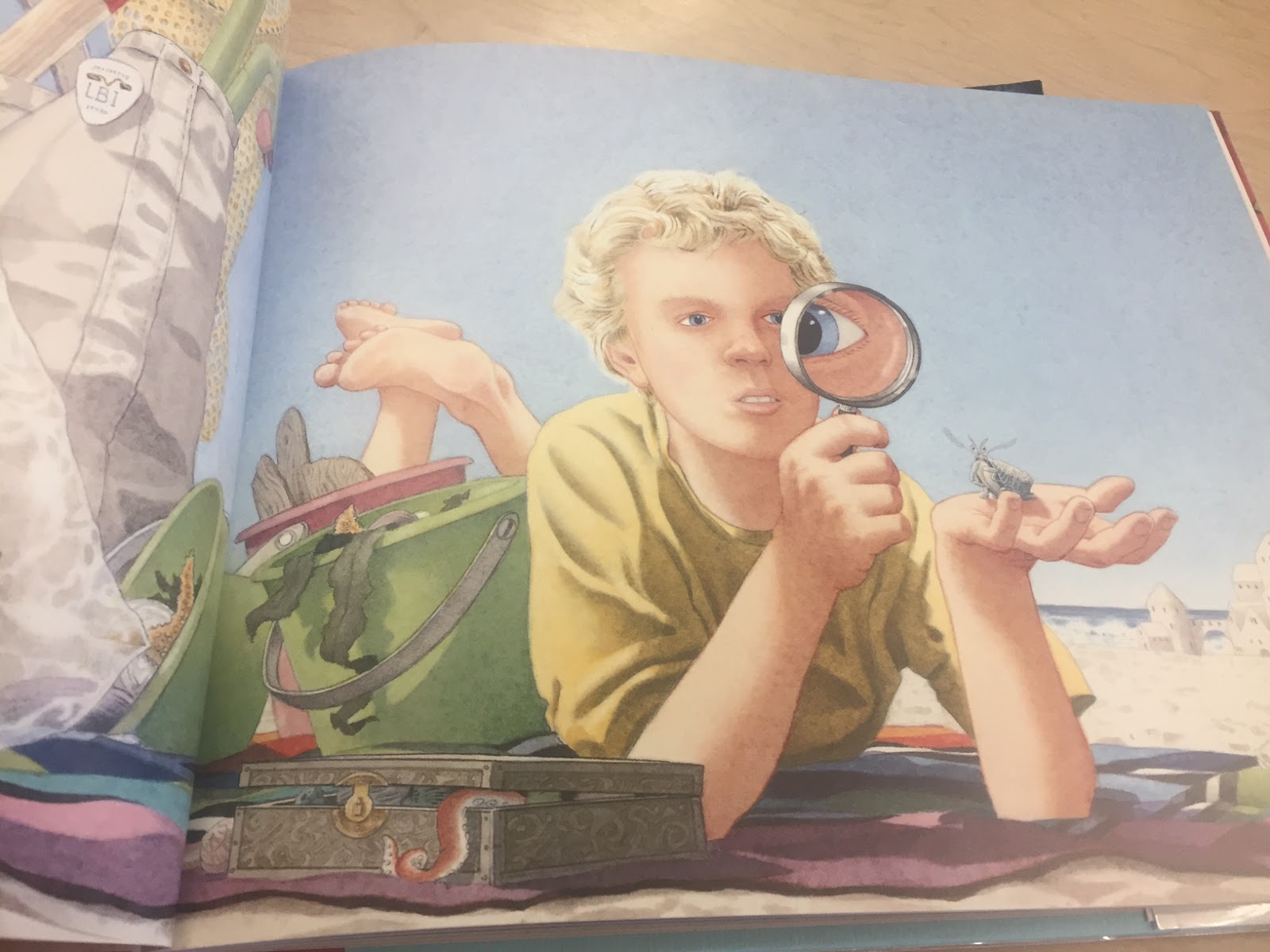
David Wiesner has a number of wordless books, most all with fantasy elements.
Tuesday is a very popular choice among the kids, but Flotsam, and Sector 7 are also fun and beautifully illustrated.
A children's librarian would have a better idea of what is locally available, but another new book that is lovely is Here I Am. Which illustrates the arrival of an immigrant child in a large city and his experience as he becomes more familiar with his surroundings.
A very cool book is Journey, by Aaron Becker. This dreamy story transports the main character through a fantasy adventure.
Pancakes for Breakfast, by Tomie DePaola, walks through the process of a grandmotherly type lady making pancakes one winter morning, beginning with collecting eggs at dawn. It embodies the humor typical of Tomie DePaola, with friendly animals.
Other titles include: The Wave by Suzy Lee, Unspoken by Henry Cole (a story of the Underground Railroad), The Flower Book by Mark Ludy, and The Girl and the Bicycle by Mark Prett.
Later, I have students write their own versions of the story, and if they have time they can redraw the illustrations and make a book.
Wordless books are so great for integrating a number of lessons, from using strong adjectives, to story telling, writing stories, increasing vocabulary, etc.
Here are some of our favorites:David Wiesner has a number of wordless books, most all with fantasy elements.
Tuesday is a very popular choice among the kids, but Flotsam, and Sector 7 are also fun and beautifully illustrated.
A children's librarian would have a better idea of what is locally available, but another new book that is lovely is Here I Am. Which illustrates the arrival of an immigrant child in a large city and his experience as he becomes more familiar with his surroundings.
A very cool book is Journey, by Aaron Becker. This dreamy story transports the main character through a fantasy adventure.
Pancakes for Breakfast, by Tomie DePaola, walks through the process of a grandmotherly type lady making pancakes one winter morning, beginning with collecting eggs at dawn. It embodies the humor typical of Tomie DePaola, with friendly animals.
Other titles include: The Wave by Suzy Lee, Unspoken by Henry Cole (a story of the Underground Railroad), The Flower Book by Mark Ludy, and The Girl and the Bicycle by Mark Prett.
Wednesday, November 18, 2015
Biography TImelines
A quick and easy way to separate main idea and details, while reading biographies and learning about the genre, is to create a timeline of a person's life. This also solidifies the idea of chronological order, has children return to text to seek out information, and gives them the opportunity to learn about an influential person.
Here are a few examples of timelines of Walt Disney's life, based on one particular biography, but we did additional research using other sources also.
Younger children or children with limited English can simply draw big events and perhaps label them, while older children can additionally write about the person's life, highlighting their accomplishments.
Here are a few examples of timelines of Walt Disney's life, based on one particular biography, but we did additional research using other sources also.
Younger children or children with limited English can simply draw big events and perhaps label them, while older children can additionally write about the person's life, highlighting their accomplishments.
Monday, November 9, 2015
The Noisy Paintbox/Abstract Art Activity
Here are some examples of their work:
Monday, July 27, 2015
Sand Art
A fun summer activity, best done outside! The kids create a outline of a simple drawing and then paint it with watercolors.
When the watercolors are dry, they go over the outline with a line of glue. Using a scoop they sprinkle sand over the outline and shake off the excess. Then, let it dry again!
Materials: Paper, pencil, watercolors, water, cups for water, colored sand, liquid glue (cardboard sheets /backing is good for to keep the paper stiff), glue sticks (if using cardboard backing)
When the watercolors are dry, they go over the outline with a line of glue. Using a scoop they sprinkle sand over the outline and shake off the excess. Then, let it dry again!
Materials: Paper, pencil, watercolors, water, cups for water, colored sand, liquid glue (cardboard sheets /backing is good for to keep the paper stiff), glue sticks (if using cardboard backing)
Tuesday, May 19, 2015
Phones
These are pieces of PVC elbow pipe, available at big hardware stores, such as Home Depot and Lowes. I use them for primarily three things: reading fluency, hearing letter sounds, and revising writing.
The sound through the pipe accentuates what they hear and they are more cognizant of how they are pronouncing. It really helps some children hear the vowel sounds that they are making.
The kids love using them and are excited to reread a book or poem while they "listen" to themselves read. They only have to read at a very low volume to hear themselves, so several children reading at the same time is not a problem.
When we are revising writing, I have the students read their writing quietly to themselves (usually sitting at an area like a writing center) and then go back and read it a second time using a blue pen to make changes. Sometimes they are reading for flow, sometimes with a purpose, such as adding strong verbs or similes and metaphors.
The piping is inexpensive and can be decorated with puffy paint, stickers, or names written in Sharpie (it wipes off with rubbing alcohol at the end of the year). It's a fun tool to have in the classroom.
The sound through the pipe accentuates what they hear and they are more cognizant of how they are pronouncing. It really helps some children hear the vowel sounds that they are making.
The kids love using them and are excited to reread a book or poem while they "listen" to themselves read. They only have to read at a very low volume to hear themselves, so several children reading at the same time is not a problem.
When we are revising writing, I have the students read their writing quietly to themselves (usually sitting at an area like a writing center) and then go back and read it a second time using a blue pen to make changes. Sometimes they are reading for flow, sometimes with a purpose, such as adding strong verbs or similes and metaphors.
The piping is inexpensive and can be decorated with puffy paint, stickers, or names written in Sharpie (it wipes off with rubbing alcohol at the end of the year). It's a fun tool to have in the classroom.
Wednesday, May 6, 2015
Tall Tales
Wednesday, March 11, 2015
Clouds
We read a few cloud books and followed up with painting clouds. This
activity can be used for younger children with creating clouds and
developing fine motor skills, or with older children studying weather
and cloud types. It's also a great way to paint snow or snowmen!

The
cloud book we started with was Little Cloud by Eric Carle. We read the
book out loud a few times and then created our own clouds on blue
construction paper. To create our cloud mixture, I mixed equal parts
liquid glue (such as Elmer's) and shaving cream. It forms a sticky,
fluffy substance (great for developing oral language and discussion)
that can be painted/sponged/finger painting/foam brushed onto paper. It
will dry almost as puffy paint, in a textured, raised bubble, depending
on how much is applied. The children then wrote a story about a cloud.
This activity is also perfect for the Cloud Book, by Tomie De Paola and creating each type of cloud.
| Various clouds by kindergarteners. |
This activity is also perfect for the Cloud Book, by Tomie De Paola and creating each type of cloud.
Monday, January 5, 2015
Gingerbread Houses
Building gingerbread houses with the students is a seasonal activity that also develops oral language, reading and writing, and integrates Common Core Standards of science and technology. Before we built the houses, we read some books about gingerbread houses (Jan Brett's The Gingerbread Baby) and a few different versions of the Gingerbread Boy.
We have also been writing and reading directions about building a gingerbread house. For older students, they read a passage from ReadWorks.com and answered questions. With the younger students, we wrote out on chart paper directions for putting together a gingerbread house. Later children wrote about constructing their gingerbread houses in an informational piece and wrote a fiction
Materials for house construction:
Non-edible: paper plates, muffin tin liners (for holding various decorating candies), small cups (Dixie cups work well for icing), popsicle sticks or knives for spreading icing, a bowl for mixing, hand mixer, if you are feeling adventurous- sandwich bags to use to "pipe" the icing
Optional: a disposable table cloth, paper towels, small (rinsed and emptied) milk or juice cartons to build around
Food items: egg whites (Egg Beaters are a good bet, they are pasteurized and no need to separate eggs), confectioner's sugar, cream of tartar, and graham crackers. For decorating- the lighter the candy, the more likely it is to stick- sprinkles, Nerds, M & Ms, chocolate chips, more traditionally- gum drops and candy canes, but they are both heavy!
There are a variety of recipes for Royal icing, the white icing that hardens when it dries, here is one that I used:
- makes 4 cups
(*if kids eat the icing, the eggs should be pasteurized)
Process:
1.) Set up and out all of the materials
Each child receives: a paper plate, a milk carton, a small cup for icing, a popsicle stick or disposable knife, 6 graham cracker pieces
2.) Make the royal icing according to recipe
3.) Children build the houses around the milk carton
4.) After 5-10 minutes of drying time (they can read or color after washing their hands) start decorating
This is a super messy (but fun) activity- be prepared!
We have also been writing and reading directions about building a gingerbread house. For older students, they read a passage from ReadWorks.com and answered questions. With the younger students, we wrote out on chart paper directions for putting together a gingerbread house. Later children wrote about constructing their gingerbread houses in an informational piece and wrote a fiction
Materials for house construction:
Non-edible: paper plates, muffin tin liners (for holding various decorating candies), small cups (Dixie cups work well for icing), popsicle sticks or knives for spreading icing, a bowl for mixing, hand mixer, if you are feeling adventurous- sandwich bags to use to "pipe" the icing
Optional: a disposable table cloth, paper towels, small (rinsed and emptied) milk or juice cartons to build around
Food items: egg whites (Egg Beaters are a good bet, they are pasteurized and no need to separate eggs), confectioner's sugar, cream of tartar, and graham crackers. For decorating- the lighter the candy, the more likely it is to stick- sprinkles, Nerds, M & Ms, chocolate chips, more traditionally- gum drops and candy canes, but they are both heavy!
There are a variety of recipes for Royal icing, the white icing that hardens when it dries, here is one that I used:
- 3 cups confectioners' sugar
- 2 egg whites, beaten
- 1/4 teaspoon cream of tartar
- makes 4 cups
(*if kids eat the icing, the eggs should be pasteurized)
Process:
1.) Set up and out all of the materials
Each child receives: a paper plate, a milk carton, a small cup for icing, a popsicle stick or disposable knife, 6 graham cracker pieces
2.) Make the royal icing according to recipe
3.) Children build the houses around the milk carton
4.) After 5-10 minutes of drying time (they can read or color after washing their hands) start decorating
| This was mad with gluten-free graham crackers, so proportions are different. |
This is a super messy (but fun) activity- be prepared!
Monday, November 10, 2014
Mighty Girls Books
The website amightygirl.com offers huge amounts of resources for teachers (and parents) to empower girls. One tool that is currently offered, is their top picks of read-alouds featuring strong women or girls.
The website itself is amazingly categorized, rich in history, contemporary women, literature and even television and movies. Definitely worth perusing!
Below is the reading list link:
Mighty Girl reading list
The website itself is amazingly categorized, rich in history, contemporary women, literature and even television and movies. Definitely worth perusing!
Below is the reading list link:
Mighty Girl reading list
Sunday, July 20, 2014
Robots
This is another speaking exercise in which students work in small groups to brainstorm ideas and then execute the illustration (or build a model if you are so inclined)!
The assignment is to design a robot that helps society in some way. You can make the assignment broad or more specific. The last time I gave it, it was with a group of fifteen year olds and we only had a half an hour to work with, so I left the assignment open, but with a time limit. When they had completed their work, they had to explain it to the class and be open for questions and conversation.
A fun extension to the assignment is to have the students write a (fiction) story about some of the robots that their classmates have designed.
Materials: chart paper, markers or crayons
The assignment is to design a robot that helps society in some way. You can make the assignment broad or more specific. The last time I gave it, it was with a group of fifteen year olds and we only had a half an hour to work with, so I left the assignment open, but with a time limit. When they had completed their work, they had to explain it to the class and be open for questions and conversation.
A fun extension to the assignment is to have the students write a (fiction) story about some of the robots that their classmates have designed.
Materials: chart paper, markers or crayons
| one example of a robot |
| another example from the same group of students |
Tuesday, July 8, 2014
Personal Timelines (Vertical format)
There are so many ways to do timelines, here is one example from an ESL summer program in which I teach. Students chose major events from their lives (birthday, a sibling's birth, entering school, etc) and recorded them on a rectangular piece of paper. We then hung them with ribbon and the students presented their own timeline to the class. This was primarily a speaking exercise, but can be used for developing writing skills also. I have used this at varying grade levels, though these students are fifteen years old.
![]() | ||
Display of class timelines.
|
![]() |
| Another rectangle on a student's timeline. |
Friday, May 30, 2014
Letters for Geometry
To practice flips (reflections), slides (translations), and turns (rotations), I make the first letter of the children's names, and the students cut them out. We then use these letters as manipulatives, so that they can demonstrate each movement on their desktop, as I call them out.
These letters can lead into another activity:
Activity link
These letters can lead into another activity:
Activity link
Wednesday, May 28, 2014
Sequencing
Two literacy extension activities the we have done recently are sequencing, during and after reading books. With older students, I give them Post It notes or index cards to keep track of major events in books. With younger students, I keep track of the events (though we discuss them as a group), on chart paper or a sequencing map. When we are finished reading, the students retell the events orally and in writing, and illustrate the sequence.
Examples of students' work from their respective reading groups:
| A series of pictures from a second grader showing the Saguaro Cactus life cycle, as shown in A Cactus Hotel. |
| After reading Abe Lincoln's Hat, a fourth grader took three major events from the beginning, middle, and end of the story, described them and drew illustrations. |
Sunday, May 25, 2014
Decimal Letters
Friday, May 16, 2014
Puppets
Puppets are such a great way for students to practice language and literacy. I have been working with students in various grades and making puppets lately. One of my second grade groups read a few plays and wrote their own, another group is performing a version of Cinderella that they read, and my fourth graders just finished Greek myth plays (from Scholastic printables).
This time, I gave them paper plates, popsicle sticks, and paper. I drew a form for the younger kids and they used it to create their puppets. The older kids wanted the freedom to make there own. Here are a few:
Thursday, May 15, 2014
Flap books for Verbs
I use flapbooks a lot and they lend themselves to being used for a variety of instruction.
Recently, we worked on irregular (simple) past tense verbs. The students made flap books with the present tense verb on the front and when the flap is opened, the irregular past tense verb on the inside.
To make a flap book, you fold the piece of paper in half and cut the top layer (like the cover of a book) to the fold, making as many cuts as you need. You will probably need to model this the first few times you do it.
.jpeg)
Recently, we worked on irregular (simple) past tense verbs. The students made flap books with the present tense verb on the front and when the flap is opened, the irregular past tense verb on the inside.
To make a flap book, you fold the piece of paper in half and cut the top layer (like the cover of a book) to the fold, making as many cuts as you need. You will probably need to model this the first few times you do it.
.jpeg)
![]() |
| Finished product |
Tuesday, May 13, 2014
Greek Mythology
After adopting the Common Core State Standards, the fourth grade curriculum changed to include aspects of Greek mythology (mostly entomology). One lesson I used when teaching Greek and Roman myths is below.
After a series of read alouds, from mythology books available at local libraries, each of the students chose a god or goddess to research. They then created a large scale drawing (I have seen this lesson done on butcher paper with life size figures) of their god/goddess. They are given a graphic organizer and each limb and part of the body houses a different teaching point. Obviously you can tailor this the ability and needs of your class.
Hints: many resources need to be read or previewed. Mythology can be gruesome and is not always age appropriate for fourth graders.
Some good and readily available titles were: A Child's Introduction to Greek Mythology The True Stories of the Gods, Goddesses, Heroes, Monsters, and Other Mythical Creatures, and D'Aulaires' Book of Greek Myths.
Organizer for Research
_____________________________________________________________________________
After a series of read alouds, from mythology books available at local libraries, each of the students chose a god or goddess to research. They then created a large scale drawing (I have seen this lesson done on butcher paper with life size figures) of their god/goddess. They are given a graphic organizer and each limb and part of the body houses a different teaching point. Obviously you can tailor this the ability and needs of your class.
Hints: many resources need to be read or previewed. Mythology can be gruesome and is not always age appropriate for fourth graders.
Some good and readily available titles were: A Child's Introduction to Greek Mythology The True Stories of the Gods, Goddesses, Heroes, Monsters, and Other Mythical Creatures, and D'Aulaires' Book of Greek Myths.
![]() |
| Organizer on chart paper |
![]() |
| Whole class teacher model |
![]() |
| Student work |
Organizer for Research
Title: The name of
your god or goddess:
Head: Adjectives describing your god or goddess (at
least 6).
______________________________________________________________________________
______________________________________________________________________________
Torso: Choose one myth that your god or goddess is
in. Summarize the myth below:
_____________________________________________________________________________
_____________________________________________________________________________
_____________________________________________________________________________
_____________________________________________________________________________
_____________________________________________________________________________
_____________________________________________________________________________
_____________________________________________________________________________
_____________________________________________________________________________
_____________________________________________________________________________
_____________________________________________________________________________
_____________________________________________________________________________
1 Arm: Write about your god or goddess' personality:
_____________________________________________________________________________
_____________________________________________________________________________
_____________________________________________________________________________
_____________________________________________________________________________
_____________________________________________________________________________
1 Arm: Write about what your god or goddesses
created:
_____________________________________________________________________________
_____________________________________________________________________________
_____________________________________________________________________________
_____________________________________________________________________________
_____________________________________________________________________________
_____________________________________________________________________________
Feet: Draw symbols of
your god or goddess.
Tuesday, April 22, 2014
Biodegradable Pots
In honor of Earth Day and spring, we recently planted seeds with the children. We made biodegradable pots using newspaper. Here are directions to print and a link to a Youtube video showing the process. Fifth graders were able to do the folding to create the pots, though they planted with their first grade buddies.
We then used popsicle sticks and paper from the recycling bucket to create flags for the plants.
Folding pots link video.
Another, easier variation on newspaper pots: Rolling newspaper pots step-by-step directions.
We then used popsicle sticks and paper from the recycling bucket to create flags for the plants.
Folding pots link video.
Another, easier variation on newspaper pots: Rolling newspaper pots step-by-step directions.
Some books (there are SO many) to connect to this activity are:
From Seed to Plant- by Gail Gibbons
Titch- by Pat Hutchins
Plant Package- by Susan Blackaby
The Carrot Seed- by Ruth Krauss
Sunflower House- by Eve Bunting
Labels:
craft,
Earth Day,
elementary,
plants,
read alouds,
recycle,
reuse,
spring,
upper elementary
Subscribe to:
Posts (Atom)


.jpeg)

.jpeg)
.jpeg)