Translate

Sunday, May 25, 2014

Decimal Letters


The kids used 10 by 10 grid paper (100 squares any size) to color the first letter of their name.  They then recorded a fraction and decimal to show how many squares were colored out of one hundred.  

Friday, May 16, 2014

Puppets

Puppets are such a great way for students to practice language and literacy.  I have been working with students in various grades and making puppets lately.  One of my second grade groups read a few plays and wrote their own, another group is performing a version of Cinderella that they read, and my fourth graders just finished Greek myth plays (from Scholastic printables).

This time, I gave them paper plates, popsicle sticks, and paper.  I drew a form for the younger kids and they used it to create their puppets.  The older kids wanted the freedom to make there own.  Here are a few:


Thursday, May 15, 2014

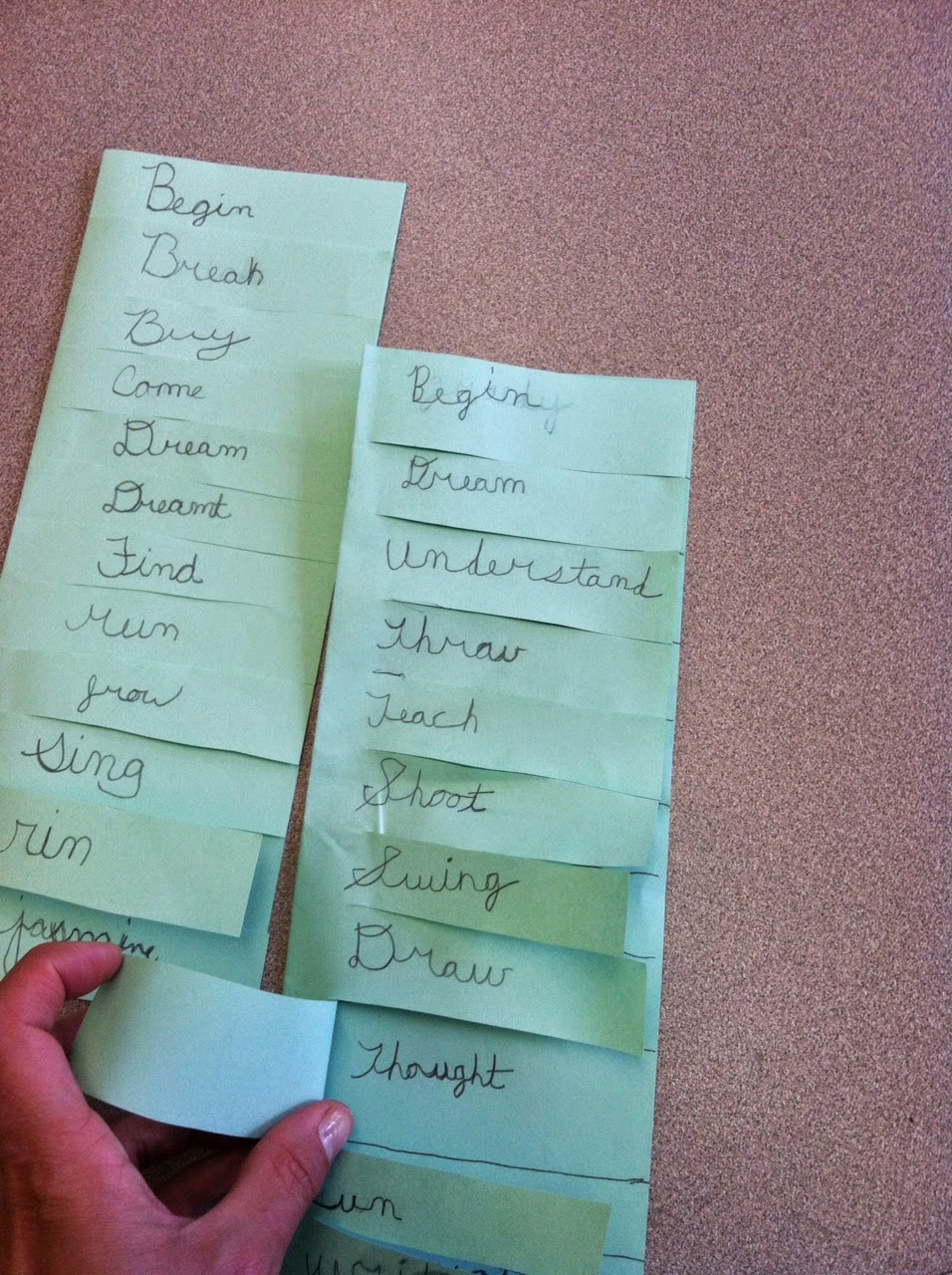
Flap books for Verbs

I use flapbooks a lot and they lend themselves to being used for a variety of instruction.

Recently, we worked on irregular (simple) past tense verbs.  The students made flap books with the present tense verb on the front and when the flap is opened, the irregular past tense verb on the inside.

To make a flap book, you fold the piece of paper in half and cut the top layer (like the cover of a book) to the fold, making as many cuts as you need.  You will probably need to model this the first few times you do it.


Finished product


Tuesday, May 13, 2014

Greek Mythology

After adopting the Common Core State Standards, the fourth grade curriculum changed to include aspects of Greek mythology (mostly entomology).  One lesson I used when teaching Greek and Roman myths is below.

After a series of read alouds, from mythology books available at local libraries, each of the students chose a god or goddess to research.  They then created a large scale drawing (I have seen this lesson done on butcher paper with life size figures) of their god/goddess.  They are given a graphic organizer and each limb and part of the body houses a different teaching point.  Obviously you can tailor this the ability and needs of your class.

Hints:  many resources need to be read or previewed.  Mythology can be gruesome and is not always age appropriate for fourth graders.
Some good and readily available titles were: A Child's Introduction to Greek Mythology The True Stories of the Gods, Goddesses, Heroes, Monsters, and Other Mythical Creatures, and D'Aulaires' Book of Greek Myths.

Organizer on chart paper
Whole class teacher model

Student work


Organizer for Research

Title:  The name of your god or goddess: 

Head:  Adjectives describing your god or goddess (at least 6).

______________________________________________________________________________

______________________________________________________________________________


Torso:   Choose one myth that your god or goddess is in.  Summarize the myth below:

_____________________________________________________________________________

_____________________________________________________________________________

_____________________________________________________________________________

_____________________________________________________________________________

_____________________________________________________________________________

_____________________________________________________________________________

_____________________________________________________________________________

_____________________________________________________________________________

_____________________________________________________________________________

_____________________________________________________________________________

_____________________________________________________________________________

1 Arm:  Write about your god or goddess' personality: 

_____________________________________________________________________________

_____________________________________________________________________________

_____________________________________________________________________________

_____________________________________________________________________________

_____________________________________________________________________________

1 Arm:  Write about what your god or goddesses created: 

_____________________________________________________________________________

_____________________________________________________________________________

_____________________________________________________________________________

_____________________________________________________________________________

_____________________________________________________________________________

_____________________________________________________________________________

Feet:  Draw symbols of your god or goddess. 


Saturday, April 26, 2014

Language and Geography

An interesting article about the development of language and sublingual groups based on geography and natural barriers and borders.  Working with children from around the world, it's fascinating to hear who can communicate with one another.  I had an Iranian student, Nepalese, and Pakistani student the other day in my classroom, insulting each other in Hindi.  Amazing ; )


Link to article on languages

Tuesday, April 22, 2014

Biodegradable Pots

In honor of Earth Day and spring, we recently planted seeds with the children.  We made biodegradable pots using newspaper.  Here are directions to print and a link to a Youtube video showing the process.  Fifth graders were able to do the folding to create the pots, though they planted with their first grade buddies.

We then used popsicle sticks and paper from the recycling bucket to create flags for the plants.


Folding pots link video.

Another, easier variation on newspaper pots:  Rolling newspaper pots step-by-step directions.


Some books (there are SO many) to connect to this activity are:  

From Seed to Plant- by Gail Gibbons
Titch- by Pat Hutchins
Plant Package- by Susan Blackaby
The Carrot Seed- by Ruth Krauss
Sunflower House- by Eve Bunting

Thursday, April 17, 2014

Easter Egg Bunnies

I found this activity in Family Circle magazine.  It's quick and easy and inexpensive.
Completed bunny.


Materials needed: 
  • plastic Easter eggs (the larger ones are easier to use & make sure they have holes on top and bottom)
  • pipe cleaners
  • a Sharpie or permanent marker
  • pom poms or cotton balls for a tail
  • a hot glue gun and glue stick
  • (goodies for inside if you are so inclined)
Steps for making the bunny:
         
Open the egg and feed the pipe cleaner through and back through the same hole to create an ear.
Pull it back through and do the same with the other half of the pipe cleaner.
Do the same for the feet.  (You can also cut the pipe cleaner in half for the feet).
Draw a face on the front with the Sharpie.
 Glue the pom-pom on the back, with the hot glue gun, for the tail.


Some books related to this activity: 

The Bunny Who Found Easter- Charlotte Zolotow
The Easter Egg- Jan Brett
The Story of the Easter Bunny- Katerine Tegen