Translate

Thursday, May 2, 2019

Books to Celebrate Ramadan

This year, in the United States, Ramadan begins on the evening of Sunday, May 5 and ends the evening of Tuesday, June 4.
Image result for lailah's lunchbox


Some books that teach and depict Ramadan, for elementary school students, include:

Lailah's Lunchbox which tells the story of a young girl from Abu Dhabi who is fasting for the first time and has recently moved to the United States.

Under the Ramadan Moon a beautifully illustrated book that describes a family celebrating during Ramadan.

Hena Khan writes the favorite character of Curious George into a board book for younger children, where George celebrates with his friend Kareem. It's Ramadan Curious George

Another popular author for younger children, Karen Katz, wrote a board book titled My First Ramadan which introduces toddlers to the holiday.

Scholastic members might like this lower level non fiction book with colorful photos from around the world. Ramadan


Image result for Ramadan Moon

Monday, April 29, 2019

Websites

Some free websites that I find useful with my students are:

Reading:
 For beginning reading skills  Reading Bear is a resource that approaches reading phonetically and begins at a very basic level, with letter sounds.


StoryWeaver allows children to hear books in both English and other languages.  Text levels are not very challenging, so it's better for younger students or beginning readers.

Math:
 To work on specific lessons and skills, Splash Math allows some free accounts for teacher's to tailor and assign tasks.

Videos & Lessons:

 Khan Academy gives lessons on a multitude of topics.

 TeacherTube gives students the advantage of watching a video of a teacher teaching lessons and is searchable by content.

Bilingual Kidspot has a variety of poetry, nursery rhymes, and videos in different languages for kids to interact with.


Thursday, January 25, 2018

Castle Unit and Read Alouds

(A work in progress)


Using castles to thematically teach in reading and writing:

References for kids:  

I Wonder Why Castles Had Moats- Philip Steele

Castles- David Macaulay


Read alouds:

A Brave Princess- Beatrice Masini
  to discuss characters

Tumble Tower- Anne Tyler


Math related:

Sir Cumference and the Round Table
 - draw and measure the perimeter or circumference of tables and/or moats
Other Sir Cumference Books

How Big is a Foot?


Writing:  

- Describe a castle in detail- project a photo on the board and brainstorm whole group descriptive words
- Write about the adventure of a knight


Wordless Books

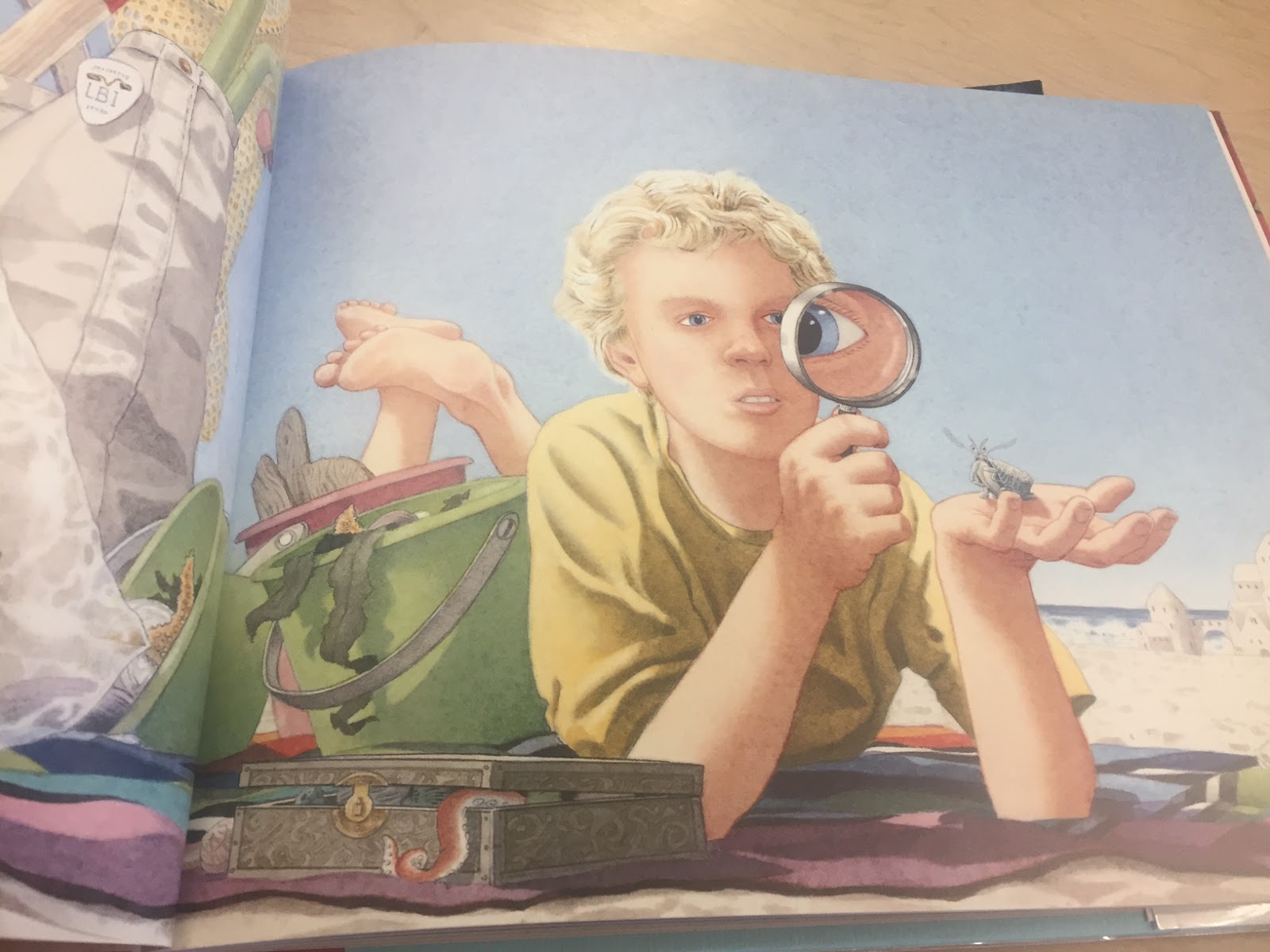
One unit that I like to do each year with my ELL students, is to work with wordless picture books.  Sometimes we sit in a small group in a read aloud format and talk through the book together, with me doing most of the talking.  At other times we each think of a line to the story as we page through the book.  Some books are available on Kindle, through local library sites, or on YouTube, so that they can be projected and charted or written the board. 

Later, I have students write their own versions of the story, and if they have time they can redraw the illustrations and make a book.

Wordless books are so great for integrating a number of lessons, from using strong adjectives, to story telling, writing stories, increasing vocabulary, etc.

Here are some of our favorites:

David Wiesner has a number of wordless books, most all with fantasy elements. 

Tuesday is a very popular choice among the kids, but Flotsam, and Sector 7 are also fun and beautifully illustrated. 

A children's librarian would have a better idea of what is locally available, but another new book that is lovely is Here I Am.  Which illustrates the arrival of an immigrant child in a large city and his experience as he becomes more familiar with his surroundings.

 A very cool book is Journey, by Aaron Becker.  This dreamy story transports the main character through a fantasy adventure. 

Pancakes for Breakfast, by Tomie DePaola, walks through the process of a grandmotherly type lady making pancakes one winter morning, beginning with collecting eggs at dawn.  It embodies the humor typical of Tomie DePaola, with friendly animals. 

Other titles include:  The Wave by Suzy Lee, Unspoken by Henry Cole (a story of the Underground Railroad), The Flower Book by Mark Ludy, and The Girl and the Bicycle by Mark Prett.


Monday, March 13, 2017

Math Superlatives

We measured some folks around the school when the students were studying centimeters (they questioned who was the tallest teacher/principal, as well as Abraham Lincoln.  I then printed photos of them and we arranged them in order from shortest to tallest, etc and used verbal statements to make comparisons. 


Since the students have now moved onto money, each of the people were assigned a handful of change, which we then counted and ordered from least to greatest and so on.

Tuesday, November 22, 2016

Thankful Mayflower boats


We read a few Thanksgiving books and then created small Mayflower boats out of cardboard, the sails listed what children were thankful for.

Materials:
brown cardboard strips (from box), stapler, brown construction paper, black and brown markers, Dixie cups, Popsicle sticks, Elmer's glue, white paper, pencils, scissors

Steps:
1.  Build a cardboard frame out of a strip of cardboard, you could also use milk cartons
2.  Cover the frame in glue
3.  Wrap the frame in construction paper (making sure there was a bottom for the Dixie cup)
4.  Draw "wooden" boards and windows on our ships
5.  Turn the Dixie cup upside down and cut a slit in the top
6.  Insert the Popsicle stick mast
7.  Write our thankful items on the white paper and cut it out
8.  Attach it to the mast


Extension(s):  the children can also create Pilgrims to ride the ship,  write about the activity from a historical event perspective, as a "how to" paper, or a fiction story from a Pilgrim's perspective


Friday, February 12, 2016

Friendship Mandalas

We talked about mandalas and looked at some examples on line.  We discussed how people create them for spiritual reasons or to calm themselves, or to create something of beauty.  I drew a circle with three rings and cut it into quarters and copied it several times.  The children worked in groups of 4 to create a design.  They had the freedom of making any design they wanted, but one element (pattern or color) had to flow with the friend next to them, so they had to have a conversation about their plan.